Dr. Michael Delahoyde
Washington State University
A MIDSUMMER NIGHT'S
DREAM
ACT III
SCENE i
Near to where Titania is sleeping, the mechanicals try to hash
out anticipated production problems and practice their play. They
are so convinced that they will be convincing that they decide to
write a prologue so that the audience will not die of fright, what
with all the swords and the lion and all. The lion should assure
them that he's not real, and the audience will need assuring that
Pyramus and Thisby are not really dying up on the stage. They also
decide they need someone to play the moon, oh, and also the wall.
It's again odd that we hear there is to be a moon on the night of
the play since there should be no moon at all according to Theseus
at the very beginning of the play (Asimov 36-37). Instead of "Ninus'
Tomb," Shakespeare has these goobers keep saying "Ninny's Tomb."
His reference to Ninus' tomb must have given pause to the Queen in
the midst of all the drollery. She would have known that Ninus was
the second husband of Semiramis, Queen of Babylon, who, although
she had made that city the most magnificent metropolis in the world,
had coupled cruelty with lust by habitually putting her lovers to
death, lest they should reveal her licentiousness. So that "Ninny's
tomb" was the grave of one who had been foolish, fatuous enough to
love the Queen! (Ogburn and Ogburn 586)
Puck eavesdrops and decides to stir things up among these yokels
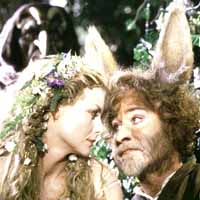
by transforming Bottom into a were-ass. Bottom's new donkey-headed
form scares off the others: "Thou art translated," exclaims Quince
(III.i.118-119). The players run off.
|
Bottom thinks they are playing a joke, as Helena does, so he sings
a proto-Paul-McCartney song to show that he is not afraid: "The
woosel-cock so black of hue [the blackbird], / With orange-tawny
bill..." (III.i.125-126) -- Oxford's colors here. But when Titania
wakes and the first thing she sees is Bottom with his ass's head,
she reels immediately with passion for him. He is disbelieving, "yet,
to say the truth, reason and love keep little company together
now-a-days" (III.i.143-144). Titania swears her love and brings him
among the fairies. He is much taken with them -- Masters Cobweb and
Peaseblossom and Mustardseed. "Bottom is amiably innocent, and not
very bawdy" (Bloom 149), "amiable enough to the infatuated Titania,
... truly charmed by the four elves" (Bloom 161).
Every exigency finds Bottom round and ready: his response is always
admirable. The Puck-induced metamorphosis is a mere externality: the
inner Bottom is unfazed and immutable. ... Like Dogberry after him,
Bottom is an ancestor of Sheridan's Mrs. Malaprop, and uses certain
words without knowing what they signify. Though he is thus sometimes
inaccurate at the circumference, he is always sound at the core, which
is what Bottom the Weaver's name means, the center of the skein upon
which the weaver's wool is wound. (Bloom 150-151)
|
The fairies are usually played by children (Wells 66), rendering
fairyland a hell-hole, of course. The 1999 film version offers
instead a truly aesthetically attractive fairyland, notwithstanding
an extraneous cameo appearance by Medusa's head. The use of the
term "Monsieur" in the scene, and the reference to "honey-bags"
(III.i.168; cf. IV.i.13ff) suggest Alençon and his request
of money-bags from Elizabeth (Clark 617-618; cf. Ogburn and Ogburn
589). Other references bring to mind Elizabeth's demands on her
maids and courtiers (Ogburn and Ogburn 588):
The moon methinks looks with a wat'ry eye;
And when she weeps, weeps every little flower
Lamenting some enforced chastity.
(III.i.198-200)
And then the last line of the scene: "Tie up my lover's tongue,
bring him silently" (III.i.201).
SCENE ii
Oberon is pleased with Puck's reports -- "Titania wak'd, and
straightway lov'd an ass" (III.ii.34) -- until it is discovered
that he got the wrong Athenian youth. Hermia accuses Demetrius
of murdering Lysander in his sleep: "O brave touch! / Could not
a worm, an adder, do so much?" (III.ii.70-71). Puck doses Demetrius
so that he'll pursue Helena instead, and he remarks on the
entertainment value of the spectacle since "Lord, what fools
these mortals be!" (III.ii.115).
The falsely enchanted Lysander enters in pursuit of Helena as
Demetrius awakens and begins exuding about Helena's divine
beauty: her eyes, her lips...
That pure congealed white, high Taurus' snow,
Fann'd with the eastern wind, turns to a crow
When thou hold'st up thy hand.
(III.ii.141-143)
|
With two men pursuing her when formerly there were none, Helena
thinks this is an elaborate mockery. She renders the famous
Shakespeare quotation: "O spite! O hell!" (III.ii.145). Lysander
also exudes: "Fair Helena! who more engilds the night / Than all
yon fiery oes and eyes of light" (III.ii.187-188). Hermia comes
upon the trio, mentioning that she was led by the sound of their
voices in the darkness, and Helena thinks she is involved also
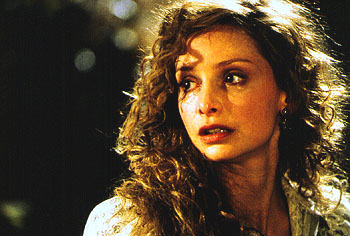
in the mockery. Hermia grows increasingly hypersensitive to
allusions to her apparently diminutive stature.
And are you grown so high in his esteem,
Because I am so dwarfish and so low?
How low am I, thou painted maypole? Speak!
How low am I? I am not yet so low
But that my nails can reach unto thine eyes.
(III.ii.294-298)
|
|
"Not only does Hermia in this way refer disparagingly to Helena
as tall and skinny (and perhaps with as little figure as a maypole),
but she also implies that the men, Lysander and Demetrius, are
dancing about her with immoral intent" (Asimov 45). Hermia's
"shrewish strain" may have captured Anne Cecil's (Ogburn and Ogburn
159, 583, 622). Helena decides, "My legs are longer though, to run
away," and Hermia concludes, "I am amaz'd, and know not what to say"
(III.ii.343-344).
Puck is delighted with the merry mix-ups, but Oberon has had enough
and instructs Puck to fix all this under cover of fog: "When they
next wake, all this derision / Shall seem a dream and fruitless
vision" (III.ii.370-371). Lost in the fog and with Puck imitating
their voices to draw them into further confusion, the individual
young lovers grow exhausted and soon sleep. Puck remarks, "Jack
shall have Jill; / Nought shall go ill" (III.ii.461-462) -- a
statement opposite to that at the end of Love's Labor's
Lost.
Act IV
Shakespeare Index