Dr. Michael Delahoyde
Washington State University
AN OXFORDIAN
WORKS LIST
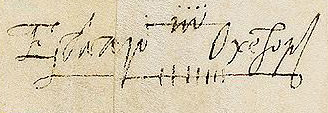
[Bold entries below are those sources most often quoted in my notes
on the plays. See also the general MLA Works List.
For a full bibliography, see James A. Warren's An Index to
Oxfordian Publications. 3rd ed. Somerville, MA: Forever Press, 2015.]
Allen, Percy. The Case for Edward de Vere Seventeenth Earl of Oxford
as "Shakespeare." London: Cecil Palmer, 1930.
Altrocchi, Paul. "Is a Powerful Authorship Smoking Gun Buried Within
Westminster Abbey?" The Shakespeare Oxford Newsletter 44.3 (Summer
2009): 1, 3-13.
Amphlett, H. Who Was Shakespeare?: A New Enquiry. London: William
Heinemann, Ltd., 1955. De Vere is the answer.
Anderson, Mark. "Shakespeare" By Another Name. NY: Gotham Books /
Penguin, 2005. An encyclopedic biography of de Vere.
Baron, Dennis. De Vere is Shakespeare. Cambridge: The Oleander
Press, 1997. A poor mega-listing of supposed name puns.
Beauclerk, Charles. Shakespeare's Lost Kingdom: The True History of
Shakespeare and Elizabeth. NY: Grove Press, 2010.
Bethell, Tom, Gail Kern Paster, et al. "The Ghost of Shakespeare."
Harper's Magazine April 1999: 35-62. Five Oxfordians and five
Stratfordians state their cases.
Bond, Jonathan. The De Vere Code: Proof of the True Author of
Shake-speares Sonnets. Canterbury: Real Press, 2009. Focuses on
the dedication page, more convincingly than I expected.
Brame, Michael and Galina Popova, ed. Secret Shakespeare's Adventures
of Freeman Jones. Adonis Editions, 2004.
---. Shakespeare's Fingerprints.
Adonis Editions, 2002. Linguistic principles show Oxford as the author of
numerous Elizabethan works and using a host of pseudonyms.
Brewster, Eleanor. Oxford and His Elizabethan Ladies. Philadelphia:
Dorrance and Co., 1972. Chapters on his relationships with his mother, sister,
wife, queen, mistress, second wife, and daughters.
Bull, Malcolm. The Mirror of the Gods: Classical Mythology in Renaissance
Art. NY: Penguin, 2005.
Chiljan, Katherine. Shakespeare Suppressed: The Uncensored Truth about
Shakespeare and his Works. San Francisco: Faire Editions, 2011.
Especially excellent with the literary context and the significant
connections from Elizabethan poets, playwrights, and works.
Clark, Eva Turner. Hidden Allusions in Shakespeare's Plays. 1931.
3rd ed. by Ruth Loyd Miller. Port Washington: Kennikat Press, 1974.
Foundational Oxfordian work in tracing historical reflections in the
plays much earlier than the traditional datings.
Davis, Frank. "Revisiting the Dating of Twelfth Night." The
Shakespeare Oxford Newsletter 38.4 (Fall 2002): 8-11, 24.
Davis, Frank M. "Shakespeare's Medical Knowledge: How Did He Acquire It?"
The Oxfordian 3 (2000): 45-58.
Desper, C. Richard and Gary C. Vezzoli. "A Statistical Approach to the Shakespeare
Authorship Question." Elizabethan Review 1.2 (Fall 1993): 36-42.
Farina, William. De Vere as Shakespeare: An Oxfordian Reading of the Canon.
Jefferson, NC: McFarland and Co., 2006.
Feldman, Bronson. Hamlet Himself. Philadelphia: Lovelore Press, 1977.
Impressively thorough autobiographical look at Hamlet with disturbing
Freudian psychoanalytic implications.
Frontline: The Shakespeare Mystery.
http://www.pbs.org/wgbh/pages/frontline/shakespeare/
Gordon, Helen Heightsman. "How Rosicrucian Friends Concealed and Revealed
Shakespeare's Secrets with Ciphers, Clues, and Symbols." Rose-Croix
Journal 8 (Spring 2011): 40-71.
---. The Secret Love Story in Shakespeare's Sonnets.
2nd edition. Xlibris, 2008.
---. "Shakespeare's Rosicrucian Revelations in the Dedication to the Sonnets."
Rose-Croix Journal 4 (Spring 2007): 1-20.
Great Oxford: Essays on the Life and Work of Edward de Vere, 17th Earl of
Oxford, 1550-1604. Ed. Richard Malim. Tunbridge Wells, UK: Parapress Ltd.,
2004.
Hernandez, Romel. "Scholar stands by theory of Shakespeare as a fraud."
The Seattle Times 4 April 1999: B4. Daniel Wright, director of the
annual Shakespeare Authorship Studies conference at Concordia University
in Portland, defends his Oxfordianism.
Hope, Warren and Kim Holston. The Shakespeare Controversy: An Analysis of
Authorship Theories. 2nd ed. Jefferson, NC: McFarland & Co., Inc., Pub.,
2009. Asserts Oxfordianism; omits PT; check p. 226.
Hughes, Stephanie Hopkins. "'Shakespeare's' Tutor: Sir Thomas Smith
(1513-1577)." The Oxfordian 3 (2000): 19-44.
Hunt, Douglas. "Arguing When Facts Are Disputed." The Riverside Guide
to Writing. Boston: Houghton Mifflin Co., 1991. 168-194. A quick
summary of the authorship issue used as a sample for rhetorical
considerations.
Jolly, Eddi. "'Shakespeare' and Burghley's Library." The Oxfordian
3 (2000): 3-18.
Looney, J. Thomas. "Shakespeare" Identified. 1920. 3rd edition by
Ruth Loyd Miller. Port Washington: Kennikat Press, 1975. The work that
launched the movement.
Magri, Noemi. Such Fruits Out of Italy: The Italian Renaissance in
Shakespeare's Plays and Poems. Buchholz, Germany: Laugwitz Verlag,
2014.
Nelson, Alan H. Monstrous Adversary. Liverpool: Liverpool
University Press, 2003. A slanderous and bungled biography of Oxford.
Ogburn, Charlton. The Mysterious William Shakespeare: The Myth and the
Reality. 2nd ed. McLean, VA: EPM Pub., 1992. Probably the most
influential Oxfordian book in the past many years.
Ogburn, Dorothy and Charlton Ogburn. This Star of England.
Westport, CT: Greenwood Press, Pub., 1952. Nearly 1300 pages and,
criminally, out of print.
Pearson, Daphne. Edward de Vere (1550-1604): The Crisis and Consequences
of Wardship. Burlington, VT: Ashgate Pub. Co., 2005.
Phillips, G[erald]. W[illiam]. Lord Burghley in Shakespeare: Falstaff,
Sly, and Others. London: T. Butterworth, Ltd., 1936.
Roe, Richard Paul. The Shakespeare Guide to Italy. NY: Harper
Perennial, 2011.
Sears, Elisabeth. Shakespeare and the Tudor Rose. Marshfield
Hills, MA: Meadow Geese Press, 2002. A handy exposure to Prince Tudor
theory.
The Shakespeare Authorship Sourcebook.
http://www.sourcetext.com/sourcebook/index.htm. Contains (or will) J.
Thomas Looney, "Shakespeare" Identified; Dorothy and Charleton
Ogburn, This Star of England; and other resources.
The Shakespeare Conspiracy. Narr. Sir Derek Jacobi. TMW Media
Group, Inc., 2000. 50 min. The star of I, C-C-C-Claudius and of
the Shakespearean episode of Frasier is the Oxfordian presenter of
the case.
Showerman, Earl. "Horestes and Hamlet." The Shakespeare
Oxford Newsletter 44.2 (Spring 2008): 1, 8-9.
Simon, Kate. A Renaissance Tapestry: The Gonzaga of Mantua.
NY: Harper & Row, Pub., 1988.
Sobran, Joseph. Alias Shakespeare: Solving the Greatest Literary
Mystery of All Time. NY: The Free Press, 1997.
Stritmatter, Roger. "De Vere's Dedicatory Poem in Cardan's
Comforte (1573)." The Oxfordian 1 (1998): 53-63.
---. "A Law Case in Verse: Venus and Adonis and the Authorship
Question." Tennessee Law Review 72 (2004): 307-355.
---. The Marginalia of Edward de Vere's Geneva Bible.
Dissertation. University of Massachusetts Amherst, 2001. And much more
about the de Vere case than the marginalia too.
Usher, Peter. "Shakespeare's Support for the New Astronomy." The
Oxfordian 5 (2002): 132-146.
Ward, Bernard M. The Seventeenth Earl of Oxford (1550-1604) from
Contemporary Documents. London: John Murray, 1928. The first full
biography, discrete concerning the authorship issue.
Warren, James, ed. An Index to Oxfordian Publications. 2nd
edition. Somerville, MA: Forever Press, 2013.
Werth, Andrew. "Shakespeare's 'Lesse Greek.'" The Oxfordian 5
(2002): 11-29.
Whalen, Richard F. Shakespeare: Who Was He? The Oxford Challenge to
the Bard of Avon. Westport, CT: Praeger Pub., 1994. Over six hundred
pages fewer than Ogburn and the work that converted me.
Whittemore, Hank. The Monument. Marshfield Hills, MA: Meadow Geese
Press, 2005. Prince Tudor theory explains the Sonnets and their
structure.
Wright, Daniel, ed. Discovering Shakespeare: A Festschrift in Honour
of Isabel Holden. Portland: Shakespeare Authorship Research Centre,
2009.
---. "'He was a scholar and a ripe and good one': The
Education of the Seventeenth Earl of Oxford, Mirrored in the Shakespeare
Canon." The Oxfordian 1 (1998): 64-87.
---. "Who Was Edward de Vere?" The Edward de Vere Studies
Conference. http://www.deverestudies.org
/who.html
---. "William Shake-speare: 'O, how that name befits my composition.'"
The Edward de Vere Studies Conference.
http://www.deverestudies.org/origins.htm
[N.B.: For further research, Ogburn and Whalen have extensive
bibliographies for all sides of the biographical issue.]
Shakespeare Biography
Shakespeare Index