Dr. Michael Delahoyde
Washington State University
HENRY V
ACT V
CHORUS
Chorus commands our imaginations to transport Henry to
"Callice" [Calais] and then across the sea to England:
You may imagine him upon Blackheath;
Where that his lords desire him to have borne
His bruised helmet and his bended sword
Before him through the city. He forbids it,
Being free from vainness and self-glorious pride;
Giving full trophy, signal, and ostent
Quite from himself to God.
(16-22)
I'm afraid I'm imagining other reasons why Henry is
not putting his supposedly battered gear on display....
Again, no evidence that he really involved himself on
the battlefield.
Although comparisons with conquering Caesar have been
declared always disparaging in Shakespeare (Goddard,
I 259), the London populace,
Like to the senators to th' antique Rome,
With the plebeians swarming at their heels,
Go forth and fetch their conqu'ring Caesar in;
As by a lower but by loving likelihood,
Were now the general of our gracious Empress,
As in good time he may, from Ireland coming,
Bringing rebellion broached on his sword,
How many would the peaceful city quit,
To welcome him!
(26-34)
Orthodoxy will continue to insist that the General alluded
to here is Essex and the Empress of course Elizabeth. But
the Irish venture was a fiasco, and the Oxfordian proposal
of a composition date in the 1580s and the reference being
to Thomas Butler, Elizabeth's commanding general in Ireland
then, makes more sense (e.g., Ogburn and Ogburn 710). Or with
Holland disguised under the Ireland reference, Chorus may be
alluding to Leicester overstepping in the 1580s (Ogburn and
Ogburn 734).
And then, making all of this a rather pointless exercise of our
imaginations, we zip over again to France. The gap between the
material from Chorus and what we see on stage has widened.
The phrase "Then brook abridgment" (44) -- meaning "tolerate
omissions" -- puns on Brook's Abridgment, published
1573/74, 1576, 1586, as the best legal textbook before Coke's
(Ogburn and Ogburn 737).
SCENE i
Fluellen is wearing a leek past the day (St. Davy's day) on
which it is a Welsh custom (see Asimov 491f). He tells Gower
that Pistol arrogantly insulted him by mocking the custom, and
when he sees Pistol he beats him and forces him to eat the leek.
After subjecting him, Fluellen gives Pistol "a groat [fourpence]
to heal your pate" (V.i.58-59): an instance of throwing money at
someone to justify shoving something down that person's throat.
Fluellen leaves, and Gower somewhat sanctimoniously insults Pistol
too. Afterwards, Pistol reports further dejection in that he has
learned that his wife -- "Doll" as a misprint for "Nell"? (Asimov
512) -- has died from "a malady of France" (V.i.82): syphilis.
Old I do wax, and from my weary limbs
Honor is cudgell'd. Well, bawd I'll turn,
And something lean to cutpurse of quick hand.
To England will I steal, and there I'll steal;
(V.i.84-87)
In other words, Henry's wars have provided an education and
opportunity for this final real result: a hardened criminal.
SCENE ii
Act V is often seen as "the worst anticlimax in any of Shakespeare's
greater plays" (Goddard, I 261). The poet seems to have run out
of material, so the act is viewed as an epilogue essentially. At best,
the act serves as a culmination among the history plays, ending "as
comedies conventionally do, with a marriage, one that will unite
realms as well as hearts" (Wells 156).
But the real effect of this act is to show us the final Machiavellian
insidiousness of Henry as he cuts such a sorry figure as a suitor --
and it doesn't matter, since the "conquest" here is already a done
deal, a foregone conclusion (Goddard, I 263). So Henry greets
the King and Queen as "our brother France" and "our sister" (V.ii.2),
with Princess Katherine "our most fair and princely cousin" (V.ii.4).
Historically, the Dauphin died two months after Agincourt (Asimov 509).
Queen Isabel expresses the hope that Henry's eyes have lost their
murderous quality (V.ii.13ff), and the Duke of Burgundy makes an
honorable speech about peace -- "sincere, profound, and imaginative,
a touchstone" (Goddard, I 262) -- including some horticultural
metaphors reminiscent of Richard II. But Henry reduces it to
the level of concessions to his conquest, to "commodity": "you must
buy that peace" (V.ii.70). The French, along with the Queen, will
review the list of demands while Henry speaks with the Princess. He
demanded her from her father as a condition of settlement: "our
capital demand" (V.ii.96).
It's a bit horrifying that the country's leaders act as if nothing
has really happened. "What it all adds up to is that the Battle of
Agincourt was the royal equivalent of the Gadshill robbery" (Goddard,
I 260). The scene amounts to more forced leek-eating, but under
the sugar-coating of Ceremony, which Henry had deconstructed earlier.
What a hypocrite! "Henry V made himself into something that comes too
close for comfort to Machiavelli's ideal prince.... Richard III was a
mere bungler: he was still conscious of his evil" (Goddard, I
267).
|
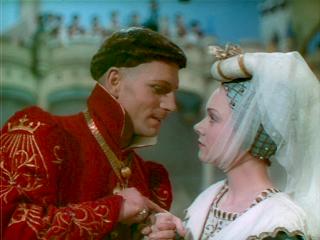
Henry's "wooing" of Katherine -- or as he calls her, Kate -- comes
off superficially as the charming comical awkwardness of a soldier
wooing an aristocratic lady. But Katherine knows that "the tongues
of men are full of deceits" (V.ii.117-118), and for all his insistences
on lacking eloquence he certainly does go on for a long time speechifying
at her. Katherine asks, "Is it possible dat I sould love de ennemie of
France?" (V.ii.169-170). To Henry, and probably most others, the match
with Katherine is a marriage of nations, not of humans. So Henry can
answer that he is not the enemy of France -- quite the opposite. That
this marriage is about rapacity for land rather than love is clear
from Henry's rhapsodizing about France itself (V.ii.172-176). At best,
after some banter about the language barrier, "I love thee cruelly"
(V.ii.202-203), "he protests, letting slip a Janus-faced adjective"
(Goddard, I 264). He thinks calling her "a good soldier-breeder"
(V.ii.206) is an appeal to maternal instincts. (And besides, it'll be
Henry VI they produce, not the world conqueror Henry envisions here.)
After substantially more dissertation from Henry, Katherine punctures
the hypocrisy of all this -- the pretense that any fate is in her hands
-- by noting that the match is entirely up to her father (V.ii.247).
Although the Princess and Alice insist it is not French custom for
ladies to kiss before marriage, Henry forces his mouth on hers.
|
|
The French nobles return, and Burgundy explains Katherine's resistence
as maidens' natural modesty regarding Cupid. Henry declares, "Yet they
do wink and yield, as love is blind and enforces" (V.ii.300-301).
Historically, Henry married Catherine de Valois on 2 June 1420 (Asimov
517). Here, it may not be so much a marriage as a rape dressed up in
"Ceremony." With the French conceding all, the "conquest" is achieved
and all look forward, incorrectly as the audience knows, to a lasting
peace.
An Epilogue in the form of a sonnet distinguishes the speaker
Chorus from the playwright:
Thus far, with rough and all-unable pen,
Our bending author hath pursu'd the story,
In little room confining mighty men,
Mangling by starts the full course of their glory.
Small time; but in that small most greatly lived
This star of England.
(Epi. 1-6)
The Epilogue points out the ultimate futility of all this pomp,
manipulation, and warfare, since Henry VI will lose France,
"Which oft our stage hath shown" (Epi. 13). So "The sense of
history as progressive is replaced by the sense of history as
cyclical" (Sutherland 124). At best, for Shakespeare, "his
essential, his persistent, his heartfelt theme" is included
in the leaving of a kingdom to a son (Ogburn and Ogburn 1199).
Henry V died on August 31, 1422. He was thirty-five years old
and he had reigned not quite ten years. Ironically, the mad
King of France outlived him, so that Henry V never succeeded
to the throne he had won. (Asimov 518)
He died "probably of a fever complicated with stomach trouble,
and, according to one account, after infernal visitations and
acute pangs of conscience" (Goddard, I 247). God, I love
this play!
Shakespeare Index