It feels as if "written for a special audience," intended for performance in the court or the house of a nobleman rather than at the public theatres (Goddard, I 48; cf. Chambers 324, Asimov 421). Oxfordians have postulated that a 1579 masque served as a primitive version of what was revised later into the play we have now: in January of 1579, a Double Maske was performed for the English court and before Simier (Miller 136; Ogburn and Ogburn 193), consisting of A Maske of Amazones and A Maske of Knightes (Ogburn and Ogburn 173, 179-180).
Even Goddard senses something Oxfordian: "In Biron we catch a glimpse of Shakespeare as it were in the very act of shaking off some of his juvenile extravagances and resolving on a greater simplicity" (Goddard, I 51).
Love's Labour's Lost implies a corresponding belief on the author's part that he who would master the means of expression must be acquainted with all its exaggerations and perversions, that he who would achieve wit in its old sense of wisdom must know every quirk and turn of "wit" in its degenerate estate, and finally that he who would attain love must be acquainted with "love's" romantic follies. (Goddard, I 49-50)
|
For an intricate read-through of the topicalities of this play, see Eva
Turner Clark's book, incorporated into Hidden Allusions in Shakespeare's
Plays (163-238) and Ruth Loyd Miller's Introduction (125-161). An actual
Berowne (or Biron), Longaville, and Dumain were French nobles involved in a
historical struggle between Henry of Navarre -- France's future King Henry IV,
from whom Oxford, we know, received correspondence (Miller 127; Farina 50) --
and the Catholic League. Armand de Gontaut, Baron de Biron was an associate
of Henry of Navarre and a military leader, who died in battle in 1592 (Asimov
424). Oxford may have liked the prominent E.O. vowel sounds in his name (Ogburn
and Ogburn 194). A Duc de Longueville was also a general of Henry's (Asimov 424).
And a historical Princess of France, Marguerite de Valois (sister to
Alençon), visited Henry late in 1578 (too early for it to have mattered
to the Stratford Shakspere) to discuss matters pertaining to towns in the
Acquitaine being held as part of a dowry settlement (Miller 130; Clark 183f).
Henry refused to receive them until a remarriage with the Protestant ritual,
the dowry paid, and towns returned. Catherine de' Medici, mother of the
Princess Marguerite, also visitedat this time with her maids of honor, called
the Flying Squadron (Ogburn and Ogburn 182-183) -- although Marguerite and
Alençon were allied against their mother, the Guises, and Henry III
(Ogburn and Ogburn 195). Mention in the play of the word "malcontent" alludes
to the anti-Guise party in France opposing Catherine de' Medici (Ogburn and
Ogburn 194). Oxford's brother-in-law Peregrine Bertie, Lord Willoughby, also
had extensive interaction with Henry of Navarre (Farina 50). Henry of Navarre,
"with a sigh and a shrug, agreed to turn Catholic" in 1593 in order to ascend
the French throne; "It is doubtful if Love's Labor's Lost could possibly
have been written in its present form after 1593, for that reason" (Asimov 424).
|
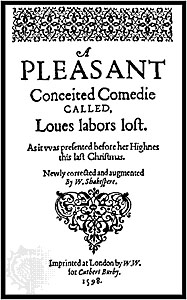
|
Ruth Loyd Miller has insisted that the play reflects Elizabeth's court in the late 1570s and early 1580s in another respect: Elizabeth had issued an edict from Ipswich in 1561 forbidding "all resort of women to the lodgings of Cathedrals or Colleges" as she objected to their interrupting studies (Miller 142; Ogburn 618). But of course she herself continued visiting within days thereafter, lodging at Cambridge (Anderson 13, 29).
Thomas Churchyard arranged and performed a Pageant of Nine Worthies before the Queen in 1578 (Farina 51).The "Academe" of Navarre, though originally inspired perhaps by the 1577 French work Academie Française dedicated to Henry III whom de Vere visited in Paris (Farina 50), may in later revision be a ridiculing of a group headed by Raleigh and including Marlowe, Chapman, and others who with John Florio thought "it were labour lost to speak of Love"; they were interested in the new science, especially astronomy and Copernicus (Goddard, I 49).
Other aspects are more accessible: figures from Roman satire and Italian commedia dell'arte, such as Armado, a stock character fromwhose name alludes to the eventually defeated Spanish Armada. Holofernes is named for Gargantua's Latin tutor in Rabelais.
Closer to home, the play contains many connections to Shakespeare's Sonnets. Shakespeare doesn't or can't distance himself from Rosaline. Berowne and Rosaline have a prehistory, and amid the sado-masochism lite, there is much poetical material about Rosaline being "dark" -- the Dark Lady of the Sonnets? Ogburn suggests that a reference to an apparently missing sequel, Love's Labour's Won, may be indicating a much earlier draft of Much Ado.
We encounter verbal and intellectual acrobatics at the sacrifice of dramatic tension and excitement. He'll be committed to more energetic plotting after this play, but this one contains a self-conscious literariness (there's an embedded sonnet in I.i.). With language as its theme, the play shows characters having idiosyncratic approaches to language, and most are castigated for it. Ladies may be ideal. Jaquenetta is largely unvocal. Moth parallels the ladies on a different level. All others are reproached. The non-pretentious Dull and Costard mock and are mocked too, so is this just a satire on pretension and pedantry? Verbal high-wire acts are the chief glory of this play, and women use this form of wit, so is language itself being satirized? Simpering wit is tiresome in other characters, but when scintillating it is not denounced.
For the ladies: language symbolizes reality; for the clowns it symbolizes things; for Holofernes and Armado, words are ends in themselves (French 94). The play takes pleasure in what is not fixed but ambiguous and shifting, although the ideal is constancy of word and spirit, heart and tongue. Only a lover and master of language and a skeptic could have exposed the linguistic manias of his day so devastatingly and merrily (Goddard, I 50).
Rima Greenhill also thinks Love's Labour's Lost has late 1570s origins, but for reasons having to do with Russian topicalities still in the play despite layers of revision: "From Russia with Love: A Case of Love's Labour's Lost" [The Oxfordian 9 (2006): 9-32]. Prompted by a few fragmented allusions mentioned by Miller and Clark (137), Greenhill explains the relevance to the play of the English Muscovy Company and the English court's dealings with Russia's Ivan the Terrible. She detects a late 1570s original composition, updated later. [For other possible topical allusions, see John Hamill, "A Spaniard in the Elizabethan Court: Don Antonio Pérez." The Shakespeare Oxford Newsletter 45.1 (June 2009): 14-23.]
ACT I
SCENE i
Ferdinand, King of Navarre, has decided that Navarre will become an Academe, a haven for the ascetic, celibate, contemplative life, where intellectual fame will assure immortality and defy "Time" (a Sonnets concern here from the very first lines). His lords -- Berowne, Longaville, and Dumaine -- are expected to sign on for three years now, although they have already sworn allegiance. Longaville and Dumaine sign readily, and Longaville reasons, "Fat paunches have lean pates; and dainty bits / Make rich the ribs, but bankrout quite the wits" (I.i.26-27). Although the monk's life is really the only available model for such a pursuit, Berowne is skeptical of the extremism and asks, "What is the end of study" (I.i.55), pointing out the necessary backfiring of the plan. "Light seeking light doth light of light beguile" (I.i.77) means that "the intellect seeking wisdom cheats eyesight out of daylight (Levin, qtd. in Bloom 126). Berowne's lines (I.i.80-93) form a sonnet, exemplifying "the frequent intellectuality of the play's style, the brilliance of its versification and its self-conscious literariness" (Wells 58-59). "How well he's read, to reason against reading!" says he King (I.i.94). "The academy plan is a sign that the King and his friends don't fully understand themselves or the nature of human nature, and it is thus, from the beginning, doomed to fail" (Garber 177).
Berowne skeptically reads the boys' clubhouse rules and is surprised that any woman (girls have cooties) coming within a mile of the court will have her tongue severed. After all, the daughter of the King of France is due on business, so he "draws his attention to the conflict between private desire and public duty" (Wells 59). "What is the end of study?" Berowne ponders, "and from then on the drama is dedicated to answering that question" (Goddard, I 49). But although he thinks the whole scheme is silly and that they'll all have to break their own rules thousands of times, Berowne submits to peer pressure and signs on. A goofy Spanish courtier, Armado, will have to suffice as far as entertainment for them now.
The academe perhaps "referred to a group of amateur scholars who gathered together in a secret group to study the new astronomy that had arisen out of Copernicus' book in 1543, which held that the earth moved round the sun and not vice versa.... Raleigh was supposed to patronize this wicked school" (Asimov 436).
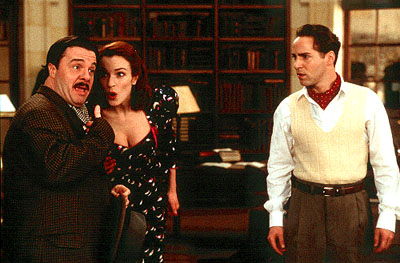
|
Constable Dull brings in local yokel Costard who has been making time
with a woman. Costard explains in a patter à la Marx Brothers.
The King reads aloud an affected letter from the puffed-up Don Armado
which contains the accusations. Costard tries to weasel around with
language to avoid the punishment, but he is sentenced to a week fasting
(although the proclaimed punishment was to have been a year's
imprisonment). Berowne begins to see vindication already.
"In Don Armado we may well be seeing the Bard's first tentative attempt at self-parody": he writes sonnets (I.ii.183) and "is both ridiculous and likeable" (Farina 53).
|
SCENE ii
Armado's exchange with his page, Moth, reveals the former as a pompous ass. For example, he prefers to say "one more than two" (I.ii.47) when he means "three." He also reveals that he loves the country girl Jaquenetta, and he wants to align himself in love with great heroes. Moth supplies Hercules and Sampson; his name is pronounced "Mote," "an allusion to his small size" (Garber 178). Jaquenetta enters with Costard and Dull and reacts to Armado either with scorn or with blankness. Armado is put in charge of Costard's punishment (now reduced to three days fasting each week). "Costard" is the name of a kind of apple (Garber 178). When all others depart, in a parody of courtly love, Shakespeare has Armado soliloquize about his love for Jaquenetta: "I am sure I shall turn sonnet" (I.ii.183-184). Thus Jaquenetta is his literary muse and Armado is a clownish version of Oxford (Anderson 261), applying his "gentle mockery" even to himself (Ogburn and Ogburn 180). Berowne is Oxford, of course (Ogburn and Ogburn 196), but Armado -- an anagram of "O. drama"? -- is Oxford's "fantastical" side (Ogburn and Ogburn 196). A reference to "cipher" (I.ii.56) may also refer to Oxford's "O" (Ogburn and Ogburn 198-199). Costard and Moth respectively note that Berowne and Armado are poor at figures (Ogburn and Ogburn 204).
Moth's association with "Juvenal" and with the mention of the fox, ape, and bee, suggests that he is a caricature of Nashe (who includes a long parable with those animals in his work of the time) (Anderson 261; cf. Asimov 427). Moth may have become the "fair youth" in a 1589 revision and before a 1598 touch-up (Ogburn and Ogburn 193). Some think Armado is Gabriel Harvey; "The Armado-Moth quibbling might therefore be taken to represent, with satiric inadequacy, the Homeric polemics of Harvey and Nashe" (Asimov 427). Armado and Moth are typically involved in exchanges of quipping, reflecting Oxford and Nashe's relationship (Anderson 262). Nashe's nemesis, Gabriel Harvey, seems to be caricatured in Holofernes (Anderson 261), and Armado eggs on the contentiousness there (Anderson 262). Costard, a caricature of William Shakspere of Stratford (Anderson 260), is an "ambitious country gentleman" and therefore "De Vere used his country clown as an envoy to satisfy the author's longing for the literary delights and public fame that he cannot himself taste" (Anderson 262). The Don Armado - Costard - Jaquenetta triad will show up in less pleasant form in As You Like It (V.i.) (Anderson 325). "And unregenerate nature is represented by the swain Costard and the wench Jaquenetta" (Wells 59). Jaquenetta may partly be Elizabeth, whom "Oxford was obliged to court in a clandestine manner" (Ogburn and Ogburn 198).
Others have thought that Armado sends up Don John of Austria (Miller 138f) and perhaps Alençon (Clark 168); Raleigh has also been suggested (Asimov 426). An "Armada" earlier than the famous 1588 Spanish fleet was the combined Venice/Spain/Rome fleet under the command of Don John in 1571 against the Turks (Clark 172). His success led to his becoming "the darling of the Western World" though he wanted Elizabeth off the throne. He was called "dramatic" and "extravagant" (qtd. in Clark 173). Armado's first name, Adriano, comes then from Adrianople, where the Sultan was at the time of the attack in 1571 (Clark 174). But Greenhill detects an original depiction of Ivan the Terrible in Armado -- thinking himself great but really the subject of mockery at the English court (Greenhill 20-21). Jaquenetta in this scheme would be the low-born seventh wife of Ivan, Mariya Nagaya (Greenhill 21).
Dull's first name, Anthony, is that of Antonio de Guaras, the King of Spain's agent in England at the time of Don John being Governor-General of the Netherlands (Clark 175). Letters revealing duplicity were at stake (Clark 176).