Dr. Michael Delahoyde
Washington State University
THE TWO NOBLE KINSMEN
This is one of the apocryphal plays, although the Stationers' Register
notes joint authorship: Shakespeare and John Fletcher. "There is no
good reason to doubt this ascription: many plays of the time did not
appear in print until long after they were written," says Stanley Wells
(381), blind to the irony about the dating of Shakespeare plays.
Three plays are now considered Shakespeare/Fletcher joint projects: this
one, the lost Cardenio, and Henry VIII -- only this last
included in the First Folio perhaps to round out the Histories sequence.
|
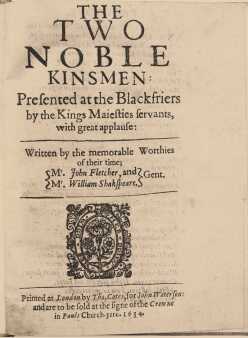
Like Pericles, this play became semi-canonical later on, published
first in a 1634 quarto edition. "It is related in style and content to
Shakespeare's romances and to tragicomedies written by Fletcher with
Francis Beaumont" (Wells 382) -- presumably meaning that it contains
"little action and minimal character portrayal" (Bloom 694). It dramatizes
Chaucer's The Knight's Tale: the rivalry between Palamon and Arcite
for Emilia. Earlier in Elizabeth's reign, Richard Edwards was credited
with a play titled Palamon and Arcite which was presented before
the Queen at the Oxford University graduation ceremonies in 1566, when
the 17th Earl of Oxford graduated. Some descriptions of this play may
touch on matters that "strongly resemble de Vere's early poetry" (Anderson
33).
The close proximity of de Vere to this acknowledged precursor for
Two Noble Kinsmen suggests that John Fletcher may have revised
and updated an old piece of Shakespeare juvenilia or perhaps a
surviving torso of an update that de Vere attempted late in life.
(Farina 55)
"The play is deeply concerned with friendship, with love, with
tensions resulting from the conflicting demands of friendship and love,
and with marriage" (Wells 385). An additional component, the Jailor's
daughter's infatuation with Palamon and going mad, is original. Otherwise
the play is laborious -- heavy with rhetoric and formal masque-like
pageantry that don't seem very Shakespearean.
|
|
PROLOGUE
The Prologue seems very un-Shakespearean. A conceit connecting "New
plays and maidenheads" (Pro.1f) is followed by a source citing --
Chaucer (Pro.13) -- and a lot of faux-humble fretting that the play
will encheesify his admirable work. But Shakespeare never otherwise
mentions Chaucer, even where one could expect something, despite being
more subtly influenced by "the father of English poetry" than has yet
been recognized.
You shall hear
Scenes, though below his art, may yet appear
Worth two hours' travail. To his bones sweet sleep!
Stanley Wells would like to think that the reference to "Our losses"
(Pro.32) is an allusion to the burning of the Globe in June 1613
(Wells 382). The Prologue is "jaunty, bawdy, and colloquial" (Garber
890). But,
one cannot help wondering if this sort of thing isn't a sign of a
certain insecurity on the part of the playwright. Uncertain as to
the worth of the play, does he call on the name of a revered ancient
as a shield against criticism? (Asimov 53)
Maybe an obsequious Fletcher (or whoever finished this play) does....
ACT I
SCENE i
The first Act is considered Shakespeare's, while most of the subsequent
three acts are considered Fletcher's (Asimov 61). After a lot of formal
pageantry signifying a wedding, we listen to a boy sing a song about
flowers and birds. The first line, "Roses, their sharp spines being
gone" (I.i.1), must allude to the motto of Queen Elizabeth's badge
(the Tudor rose): "Rosa sine Spina" ("a rose without a thorn").
The "Daisies" (I.1.5), like Twelfth Night's violets and key flowers
in A Midsummer Night's Dream, are "forget-me-nots." The second stanza
begins with "Primrose, first-born child of Ver" (I.i.7), an obsolete term
for Spring (Asimov 56) among other things. If "her bells" (I.i.9) are
"harebells" as editor Skeat suggested in 1875, then they signify submission.
Next come "Oxlips" (I.i.10), "Marigolds" (I.i.11) for grief, and "Larks'-heels"
(I.i.12). Flowers are strewn before a stanza-plus concerning birds. The
reference to "bridehouse" (I.i.22) resurrects a handy medieval instance of
metathesis of the 'r'.
Three veiled queens in black interrupt the proceedings at Athens by
falling at the feet of Theseus (titled "Duke" here as in A
Midsummer Night's Dream and, indeed, Chaucer), his bride Hippolyta,
and her sister Emilia -- this last "a character who does not belong to
classical mythology at all, but to medieval fiction" (Asimov 56). They
have a request to make of Theseus, and "This good deed / Shall raze
you out o' the' book of trespasses / All you are set down there"
(I.i.32-34). Their dead husbands are the victims of "The wrath of
cruel Creon" (I.i.40), king of Thebes.
The Queens' supplicating laments are ritualistic, essentially baroque
in their elaborations. The luxuriance, not so much of grief, but of
outrage dominates. Outrageousness is the rhetorical tonality of
Shakespeare's final mode, where most voices carry the burden of having
been outraged: by injustice, by time, by eros, by death. (Bloom 699)
Theseus is courteous but also moved: "Pray you kneel not; / I was
transported with your speech, and suffer'd / Your knees to wrong
themselves" (I.i.54-56). Amid their superfluous pleadings, Theseus
recalls the beauty of one of the queens: "O grief and time, /
Fearful consumers, you will all devour!" (I.i.69-70). The second
queen appeals to Hippolyta, using the nonce word "soldieress" (I.i.85)
and adding a gruesome bit of courtesy: "Lend us a knee; / But touch
the ground for us no longer time / Than a dove's motion when the head's
plucked off" (I.i.96-98). Much here seems genuinely Shakespearean; and
Wells says about the long address to Hippolyta (I.i.77-101),
The complex rhetoric of the speech, with its sixteen-line first sentence,
tortuous in construction, piling subordinate clauses one on top of another,
some in apposition, some subordinate to others, with its qualifying and
parenthetical clauses, its figurative language, its mixture of concrete
and abstract expressions, its coined compounds ('scythe-tusked' and, later,
'blood-sized'), its invented words ('soldieress', not previously recorded),
its inversions and ellipses and elisions, its run-on verse lines and feminine
endings, and the grotesque imagery of the concluding lines, amounts almost
to a parody of Shakespeare's late style, making no concessions to either
the speaker of the hearer.... (Wells 383-384)
The third queen to Emilia says, "my petition was / Set down in ice,
which by hot grief uncandied / Melts into drops" (I.i.106-108).
Theseus agrees to lead an army against Creon, and the queens urge
immediacy: "Now you may take him / Drunk with his victory." "And his
army full / Of bread and sloth" (I.i.157-159). The first queen compliments
Theseus on the basis of reputation: "Thus dost thou still make good / The
tongue o' th' world" (I.i.226-227). Theseus furthers this Shakespearean
theme: "As we are men / Thus should we do, being sensually subdu'd / We
lose our human title" (I.i.231-233).
SCENE ii
Palamon and Arcite are cousins, "creations strictly of the medieval
romances" (Asimov 60) with "somewhat priggish moral character" and
"no personality" (Bloom 701). Arcite proposes they leave Thebes and
its temptations "before we further / Sully our gloss of youth"
(I.ii.4-5). Palamon frets extraneously over being expected (by whom?)
to follow others' manners of gait, speech, fashion (I.ii.42-62). They
seem to feel that "Affectations of style, speech, and dress have
overtaken the court of Creon" (Garber 893). They sound more fed up
with Elizabethan court than ancient Thebes. These two are also nephews
of Creon, whom they acknowledge is "A most unbounded tyrant" (I.ii.63)
and from whom they distance themselves morally: "Let / The blood of
mine that's sib to him be suck'd / From me with leeches! let them
break and fall / Off me with that corruption!" (I.ii.71-74). They
cannot be "his kinsmen / In blood unless in quality" if they stay
(I.ii.78-79).
Yet when Valerius calls upon them in the name of the King, they agree
to fight for the sake of Thebes.
SCENE iii
Hippolyta and Emilia send their best wishes to Theseus through Pirithous.
The scene includes a "grotesque vision" that creates an "alienation
effect" (Bloom 702) in Hippolyta's reference to wartime scenes of "babes
broach'd on the lance, [and] women / That have sod their infants in ...
/ The brine they wept at killing 'em" (I.iii.20-22). Hippolyta also
displays an "uncanny dispassionateness" (Bloom 702) in her description
of Theseus and Pirithous' army experiences, ending with the thought that
"Theseus cannot be umpire to himself, / Cleaving his conscience into
twain and doing / Each side like justice, which he loves best"
(I.iii.45-47).
Emilia defends Theseus and Pirithous' closeness, telling Hippolyta that
she herself could never love any man, only another maiden such as her
youthful chum Flavina, with whom she was so much in tune that if she
put a flower between her breasts then Flavina would whimper until she
had one to place between her own. "The contrast between this union of
serenities and the murderous violence of the Palamon-Arcite strife for
Emilia could not be more persuasive" (Bloom 704). If Hippolyta believed
a word of this she'd be so upset she'd have to consider breaking up
with Theseus, but she's sure the silly girl doesn't know what she's
saying.
SCENE iv
Theseus triumphs in the big war so the queens are pleased. Among the
victims, Palamon and Arcite are near death but have impressed Theseus
greatly: "I fix'd my note / Constantly on them; for they were a mark /
Worth a god's view" (I.iv.19-21). "The very lees of such (millions of
rates) / Exceed the wine of others" (I.iv.29-30). He sends for doctors.
SCENE v
The queens escort hearses with their dead husbands to the tune of a
snappy little dirge. The third queen ends the Act, remarking, "This
world's a city full of straying streets, / And death's the market-place,
where each one meets" (I.v.15-16).
Act II
Shakespeare Index