
 Virginia I. Lohr
Emeritus Professor
Dept. of Horticulture
Washington State University
Pullman, Washington, 99164-6414, U.S.A.
 Hort 330:
Landscape Plants for Urban and Community Environments
Hort 330:
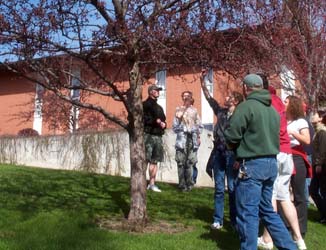
Landscape Plants for Urban and Community Environments- Plants for solving problems in human-dominated landscapes: their characteristics, functions such as storm water management and climate change mitigation, ecology, identification, and selection.
Hort 331: Landscape Plant Installation and Management - Principles and practices for installation and management of landscapes; specifications, site preparation, transplanting, growth control, problem diagnosis.
Hort
231: Landscape Plant Materials I
Hort
232: Landscape Plant Materials II
- People's responses to tree
canopy colors.
- Influence of childhood environmental experiences on adult sensitivities to forests.
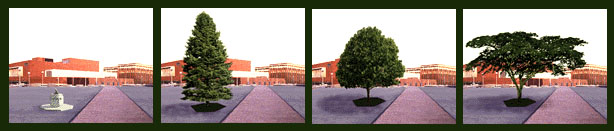
- People's responses to trees of different forms.
- Impact of interior plants on people's perceptions of discomfort.
- Impact of interior plants on air quality and on human stress and productivity.
- Rain
gardens: Experiences of practicing landscape
professionals.
- Issues with low biodiversity and genetic diversity in urban landscapes.
- Adoption
of creek-side residential landscapes to improve
water quality.
- Water conservation in landscapes.
V.I. Lohr.
2016. Proc. 29th International Horticultural
Congress, Brisbane, AU. Acta Horticulturae
1121:103-108.
Childhood experiences in nature with adults who are important to a child are particularly important.
Author text PDF
Childhood experiences in nature with adults who are important to a child are particularly important.
Author text PDF
Klein, L.R., W.G.
Hendrix, V.I. Lohr, J.B. Kaytes, R.D. Sayler, M.E.
Swanson, W.J. Elliot, and J.P. Reganold. 2015.
Landscape and Urban Planning 134:195-209.
Buffers improve ecological and aesthetics of agricultural lands.
Press release
Buffers improve ecological and aesthetics of agricultural lands.
Press release
Kendal, D., C. Dobbs,
and V.I. Lohr. 2014. Urban Forestry &
Urban Greening 13(3):411-417.
Diversity in urban trees is still lacking; few cities world-wide have 10% or less of any single species of tree.
Abstract
Diversity in urban trees is still lacking; few cities world-wide have 10% or less of any single species of tree.
Abstract
Polakowski, N.R.,
V.I. Lohr, and T. Cerny-Koenig. 2011.
Arboriculture & Urban Forestry 37:259-264.
Industry superficially understands the problem.
Full text PDF
Industry superficially understands the problem.
Full text PDF
Lohr, V.I.
2010. Acta Horticulturae 881(2):675-682.
We are beginning to understand why people might respond positively to plants indoors and out.
Author text PDF
We are beginning to understand why people might respond positively to plants indoors and out.
Author text PDF
Kaufman, A.J. and
V.I. Lohr. 2008. Acta Horticulturae
790:179-184.
All canopy colors are calming, but medium green was the most calming.
Abstract
All canopy colors are calming, but medium green was the most calming.
Abstract
Lohr, V.I.
and C.H. Pearson-Mims. 2006. Environment
& Behavior 38(5):667-688.
People feel happier looking at any
tree rather than no tree, but feel happiest when it
has a spreading form.
Abstract
Abstract
Lohr, V.I. and C.H.
Pearson-Mims. 2005. HortTechnology
15:472-476.
Children who play around trees and
who plant flowers appreciate the value of trees as
adults.
Abstract
Abstract
Lohr, V.I., C.H.
Pearson-Mims, J. Tarnai, and D.A. Dillman.
2004. Journal of Arboriculture 30(1):28-36.
Lohr, V.I.
and C.H. Pearson-Mims. 2000. HortTechnology
10(1):53-58.
People tolerate pain better when plants are around.
Abstract
People tolerate pain better when plants are around.
Abstract
Lohr, V.I.
and C.H. Pearson-Mims. 1996. Atmospheric Environment
30(14):2565-2568.
Lohr, V.I.,
C.H. Pearson-Mims, and G.K. Goodwin. 1996. J. of
Environmental Horticulture 14(2):97-100.
Berge, B.
and V.I. Lohr. 1994. In: M. Francis, P. Lindsey, and J.
S. Rice. The healing dimension of people-plant
relations: Proceedings of a research symposium, p.
101-113. The University of California, Davis, CA.
Teenagers like trees.
Lohr, V.I.
and L.H. Bummer. 1992. HortTechnology 2:253-256.
Lohr, V.I.
1989. HortScience 24:737-739.
Applied classes can be
intellectually rigorous.
- Sabbatical leaves:
- Visiting Fellow, Fenner School of Environment & Society, Australia National Univ., Canberra, 2012-13.
- Aix-en-Provence, France, 2002-2003.
- Univ. of Michigan and Virginia Polytechnic Institute and State Univ., 1991-1992.
- Pi Alpha Xi Photography Contest:
- 2014: 1st, 2nd, and 3rd
places.


- 2013: 3rd place.

- 2011: 2nd and 3rd
places.

- 2005: 2nd place.
- Invited Speaker:
- Australian
National Botanic Gardens Thursday Talks,
Canberra, Australia, 2013.
- 28th International Horticultural Congress, Colloquium Speaker, Lisbon, Portugal, 2010.
- International Workshop on Health, Environment and
Town/Life Planning for Sustainable Welfare Society,
Kashiwa, Japan, 2009.
- Visiting Scientist:
- Japanese Society for the Promotion of Science Invitation Fellowship, Japan, 2005.
- NSF Advance Program, NMSU, Las Cruces, NM, 2005.
- Editorial Board:
- HortTechnology, 2011 - 2014.
- ISHS Acta Horticulturae 881, 2nd International Conference on Landscape and Urban Horticulture, 2009.
- Doctoral
Dissertation Review:
- Department of Work Science, Business Economics &
Environmental Psychology, Swedish Univ. of
Agricultural Sciences, Alnarp, Sweden, 2014.
- Department of Agriculture & Ecology, Univ. of Copenhagen, Denmark, 2011.
- Department of Resource Management & Geography,
The University of Melbourne, Australia, 2011.
- Program Review:
- Department of Plant Sciences, University of Tennessee, 2004 and 2010.
- Department of Plant Sciences, North Dakota State University, 2006.
- Department of Horticulture, Virginia Polytechnic Institute and State University, 2003.
- WSU President's Teaching Academy, selected 2007.
- Horticulture Undergraduate Curriculum and Recruitment Committee, Co-Chair, 2014-2016.
- WSU Common Reading Selection Committee, 2011-12.
- Horticulture and Landscape Architecture Strategic
Planning Committee, 2011.
- WSU Learning Goals Revisioning Committee, 2010.
- WSU Arboretum and Wildlife Center Planning Committee, 2008-2009.
- WSU Faculty Affairs Committee, 2004-2008.
- Association for Faculty Women, WSU, Web Wizard, 2003-2006.
- Current Position:
- Emeritus Professor, Department of Horticulture,
Washington State University, Pullman, WA
(retired June 30, 2016).
- Before coming to WSU:
- Taught at The University of Tennessee and at New Mexico State University
- Managed garden centers in Colorado
- Served as the first intern at the Scott Arboretum at Swarthmore College
- Education:
- Ph.D. - University of Tennessee - Plant and Soil Science
- M.S. - New Mexico State University - Horticulture
- B.A. - Swarthmore College - Psychology
Dr. Virginia
I. Lohr, Emeritus Professor
Department of
Horticulture
Washington State University
Pullman, Washington 99164-6414 U.S.A.
E-mail: lohr@wsu.edu
Washington State University
Pullman, Washington 99164-6414 U.S.A.
E-mail: lohr@wsu.edu
Page updated
October 23, 2017