Dr. Michael Delahoyde
Washington State University
A MIDSUMMER NIGHT'S
DREAM
ACT II
SCENE i
"In earlier centuries fairies were taken much more seriously,
and well they might be.... They were mysterious forces of nature,
usually capricious, often malevolent" (Asimov 26). We meet the
mischievous fairy Puck, a king of the elves in Scottish mythology
(Asimov 29), and hear of the minor pranks he plays on humans, such
as pulling out a stool when someone goes to sit down (II.i.52f).
Robin Goodfellow, another name of his, is mentioned in Anthony
Munday's comedy Two Italian Gentlemen, printed in 1584 --
and Munday was in Oxford's service then (Clark 624).
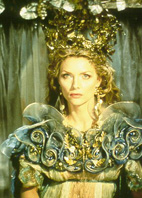
Oberon, the king of the fairies, enters fighting with his queen
Titania due to jealousies over their respective devotions to
Hippolyta and Theseus (II.i.70ff), but also and primarily over
a "changeling" boy (II.i.23f). Productions often will have the
Theseus and Hippolyta actors doubling with these parts (Garber
215). The argument here includes reference to Theseus' checkered
past with the ladies: Ariadne et al. (II.i.77-80). "The playwright
could easily have omitted this reference to Theseus' infidelities,
which seem so out of character" (Garber 229). The elder Ogburns
explain the argument as a representation of the 1583 reconciliation
discussion Oxford had with Elizabeth "after bitter words and
speeches," "reminding her of her own misdeeds" and thinking of
Theseus as Leicester (Ogburn and Ogburn 587).
"At one point Ovid uses the name 'Titania' for the moon, referring
to Phoebe.... This, after all, is a moon-drenched play, a tale of
fantastic doings in the dim-lit night. It may have pleased Shakespeare
to have the Fairy Queen a version of the moon goddess" (Asimov 26-27).
The mutual jealousies of Titania and Oberon apparently tend to create
havoc in the natural world (II.i.88ff), and weather in England was a
misery around the years 1594-1596 (Asimov 32).
And this same progeny of evils comes
From our debate, from our dissention;
We are the parents and original.
(II.i.115-117)
The changeling boy is "the object of desire. He represents, in
effect, the powerful irrationality of desire itself" (Garber 220).
(Maybe not so abstract, say Prince Tudor proponents.) The fairies'
argument is at an impasse, and Titania will not relinquish the child.
She departs.
Oberon informs Puck that he once heard singing "a mermaid on the
back of a dolphin" (II.i.150). In 1575, part of Leicester's
entertainment at Kenilworth for Queen Elizabeth was "Arion" singing
on the back of a mechanical dolphin (Farina 56). Oberon has Puck
fetch a magic potion that will fire up Titania's passion for whatever
creature she sees upon first waking:
|
That very time I saw (but thou couldst not),
Flying between the cold moon and the earth,
Cupid all arm'd. A certain aim he took
At a fair vestal throned by the west,
And loos'd his love-shaft smartly from his bow,
As it should pierce a hundred thousand hearts;
. . .
It fell upon a little western flower,
Before milk-white, now purple with love's wound,
And maidens call it love-in-idleness.
(II.i.155-168)
|
The passage is the most direct homage to Queen Elizabeth in the
canon (Asimov 33). [And note the reference to "leviathan" also
(II.i.174), which connects Polonius with Lord Burghley in
Hamlet.] "Love-in-idleness" is identified in glosses as
the pansy, whose name comes from the French "pensée" --
thought/to think on (hence, forget-me-not), but also thought
expressed in literary form.
She passes on, and remains fancy-free; the arrow of Cupid, unable
to wound the Virgin Queen, instead converts the pansy into a universal
love charm. It is as though Elizabeth's choice of chastity opens up
a cosmos of erotic possibilities for others, but at the high cost of
accident and arbitrariness replacing her reasoned choice. Love at first
sight, exalted in Romeo and Juliet, is pictured here as calamity.
(Bloom 159)
In any case, Oberon's plan is to slip Titania a mickey: the juice of
the flower placed on a sleeper's eyes will make the victim fall in love
with whatever it first sees when woken -- even a lion or a bear or an
ape. "But why should Oberon, who is not jealous of Theseus, and is
willing to be cuckolded by Titania's enchantment, feel so fiercely
in regard to the changeling's custody? Shakespeare will not tell us"
(Bloom 157). The changeling is called Titania's "page" at one point
(II.i.185).
The fairies are invisible to Demetrius and to Helena who pursues him.
He is looking for Hermia: "Thou toldst me they were stol'n unto this
wood; / And here am I, and wode within this wood" (II.i.191-192). So
Demetrius puns on the issue of madness; "the move is not merely a physical
one from the court to the country, it is also a move of the mind, pointed
by a pun" (Wells 65; cf. Garber 217). Helena insists, "I am your spaniel;
and, Demetrius, / The more you beat me, I will fawn on you. / Use me but
as your spaniel; spurn me, strike me..." (II.i.203-205). Not the
healthiest of relationships! Helena laments her female state:
We cannot fight for love, as men may do.
We should be woo'd, and were not made to woo.
I'll follow thee and make a heaven of hell,
To die upon the hand I love so well.
(II.i.241-244)
Oberon witnesses this pathetic situation and plans to reverse it with
the potion so that Demetrius will pursue Helena instead. Puck returns
with the potion and is instructed to dose the Athenian youth. Oberon
will dose Titania.
The name Oberon comes a French softening of the Teutonic "Alberich" in
Huon of Bordeaux, translated into English in 1540. He is said
to have been born to Julius Caesar and Morgan le Fay! (Asimov 27-28).
Instead of the "Auberon" form, Shakespeare uses a combination of "O"
and "Beron" (= Berown, the self-portrait in Love's Labor's Lost?).
In the late 1700s, Oberon and Titania were appointed as the names of
Uranus' two outermost satellites (Asimov 28).
SCENE ii
|
Titania and her entourage engage in important ritualistic fairy work.
The play contains three references to musk-roses, including one here
(II.ii.3; cf. II.i.252, IV.i.3), and no other play mentions them even
once. "In 1582, Hakluyt gave the date of the introduction of the musk-rose
into England as being then quite recent. Lord Burghley, with his marvellous
gardens, would have been among the first to own specimens of the fragrant
new flower, and there Lord Oxford would have seen it" (Clark 625; cf.
Ogburn and Ogburn 594).
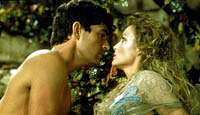
The fairies sing Titania to sleep. Oberon enters and sprinkles her
eyelids with the pansy juice.
|
|
Hermia and Lysander approach and are ready to sleep also, if Hermia
can convince Lysander to "Lie further off" (II.ii.44, 57). Puck comes
upon them and thinks Lysander, "this lack-love, this kill-courtesy"
(II.ii.77), is the Athenian youth Oberon meant. He doses him.
Helena continues her pursuit of Demetrius and also comes across the
sleeping couple. So the first thing Lysander sees on waking is Helena,
and now he pursues her, much to her confusion. What about Hermia?
"Content with Hermia? No; I do repent / The tedious minutes I with
her have spent" (II.ii.111-112). Helena even thinks that this is some
kind of "mockery" of her (II.ii.123), and she runs off. Lysander views
the sleeping Hermia:
For as a surfeit of the sweetest things
The deepest loathing to the stomach brings,
Or as the heresies that men do leave
Are hated most of those they did deceive,
So thou, my surfeit and my heresy,
Of all be hated, but the most of me!
(II.ii.137-142)
He runs off in pursuit of Helena. Hermia wakes up from a bad dream
that intrigues psychoanalytic critics, calling for Lysander's help
"To pluck this crawling serpent from my breast" (II.ii.146); "Methought
a serpent eat my heart away, / And you sate smiling at his cruel prey"
(II.ii.148-149). But no one is around.
Act III
Shakespeare Index