Dr. Michael Delahoyde
Washington State University
HENRY V
ACT IV
CHORUS
Chorus paints the scene of both camps on the night before the battle.
Again, we are instructed to supply our imaginations to the material.
We'll be getting "A little touch of Harry in the night" (47). Chorus
laments the fact that there will be low-class characters included in
the scenes, disgracing "The name of Agincourt. Yet sit and see, /
Minding true things by what their mock'ries be" (52-53). So goofy
underplots reveal truths....
SCENE i
Henry tells Gloucester that although it's true they are disastrously
outnumbered, "There is some soul of goodness in things evil" (IV.i.4):
the better to rally courage among the English. Sir Thomas Erpingham
is glad and honored to be here with the King. Henry buys himself some
time: "I and my bosom must debate a while" (IV.i.31).
Henry, perhaps borrowing a cloak, disguising himself enough to wander
among the common soldiers at night. Is this another manifestation of
the Shakespeare insomnia (Ogburn and Ogburn 472)? He encounters first
Pistol, who asks, "art thou officer, / Or art thou base, common, and
popular?" (IV.i.37-38). Henry presents himself as "Harry le Roy" to
Pistol, who is trash-talking Fluellen.
Fluellen and Gower pass by, Fluellen griping that there's too much
chatter: "If you would take the pains but to examine the wars of
Pompey the Great, you shall find, I warrant you, that there is no
tiddle taddle nor pibble babble in Pompey's camp" (IV.i.68-71).
Gower notes that the enemy camp is making noise, but Fluellen
asks everyone's mother's question: "If the enemy is an ass and a
fool, and a prating coxcomb, is it meet, think you, that we should
also, look you, be an ass and a fool, and a prating coxcomb, in
you own conscience now?" (IV.i.77-80). Henry secretly decides
that Fluellen is a bit weird -- "out of fashion" (IV.i.83) --
but okay.
Henry chances upon three soldiers: John Bates, Alexander Court, and
Michael Williams -- the stuff England is made of. These genuine men
speculate about the King, and Henry first insists on his common
humanity with them, although with an elitist falconry metaphor:
"though his affections are higher mounted than ours, yet when they
stoop, they stoop with the like wing" (IV.i.106-107). This scene
purportedly shows Henry as simple, modest, democratic -- if this
were Henry (see Goddard). Under the cover of night and costume,
he becomes almost the old Hal. He had to disguise himself to become
king; now he must disguise himself to become a man. The soldiers,
on the other hand, have the courage of hopelessness. Discussion
turns to the King's "cause being just and his quarrel honorable."
"That's more than we know" (IV.i.127-129), says Williams.
But if the cause be not good, the King himself hath a heavy
reckoning to make, when all those legs, and arms, and heads,
chopp'd off in a battle, shall join together at the latter day
and cry all, "We died at such a place" -- some swearing, some
crying for a surgeon, some upon their wives left poor behind
them, some upon the debts they owe, some upon their children
rawly left. I am afeard there are few die well that die in
battle; for how can they charitably dispose of any thing, when
blood is their argument? Now, if these men do not die well, it
will be a black matter for the King that led them to it....
(IV.i.134-145)
Williams knows the grisly consequences will befall only the
commoners and wonders if the cause for the war is just. Asimov
dismisses Williams as "gloomy" and someone "who even dares to
wonder openly" about the justice of the cause for which they are
fighting (Asimov 492). Asimov focuses on the style of the encounter,
with the King answering Williams "so vigorously that it comes to a
quarrel" (Asimov 493), without addressing the content of the debate.
Henry's response is a long prose speech against the logic of holding
the king responsible: a speech amounting to "squirming sophistry"
(Goddard, I 242).
So, if a son that is by his father sent about merchandise do
sinfully miscarry upon the sea, the imputation of his wickedness,
by your rule, should be impos'd upon his father that sent him; or
if a servant, under his master's command transporting a sum of
money, be assail'd by robbers and die in many ireconcil'd iniquities,
you may call the business of the master the author of the servant's
damnation. But this is not so. The King is not bound to answer the
particular endings of his soldiers.... (IV.i.147-156)
Henry then supposes the soldiers who die may have already accrued
other sins: "Now, if these men have defeated the law and outrun
native punishment, though they can outstrip men, they have no wings
to fly from God" (IV.i.166-169). So war is God's way of winnowing
sinners. "The King was willing to put the responsibility on an
archbishop but he is unwilling to let his soldiers put the
responsibility on a king" (Goddard, I 242). Henry insists
that he heard the King say he "would not be ransom'd." Williams
retorts, "Ay, he said so, to make us fight cheerfully; but when
our throats are cut, he may be ransom'd, and we ne'er the wiser"
(IV.i.190-194). Rather than fight now, Williams and Henry agree
to wear each other's tokens, and if they live, meet after the
battle and duel. Williams says, "Keep thy word; fare thee well"
(IV.i.221).
Then alone, Henry delivers a deep democratic speech about how
tough it is to be a king, and how comparatively stressless to
be a peasant: what an idyllic life led by the wretched.
And what have kings, that privates have not too,
Save ceremony, save general ceremony?
And what art thou, thou idol Cermony?
(IV.i.238-240)
Queen Elizabeth had said at some unknown time, "To be a king
and wear a crown is more glorious to them that see it than it
is a pleasure to them that bear it" (qtd. in Ogburn and Ogburn
730). Henry's dissertation on Ceremony all sounds good but
doesn't tend to translate into his deeds.
Erpingham returns and calls Henry to a meeting of the nobles.
Henry has one more lone moment, during which he prays to "the
God of battles" (IV.i.289) -- Mars?
Not to-day, O Lord,
O, not to-day, think not upon the fault
My father made in compassing the crown!
I Richard's body have interred new,
And on it have bestowed more contrite tears,
Than from it issued forced drops of blood.
Five hundred poor I have in yearly pay,
Who twice a day their wither'd hands hold up
Toward heaven, to pardon blood; and I have built
Two chauntries, where the sad and solemn priests
Still sing for Richard's soul. More will I do;
Though all that I can do is nothing worth,
Since that my penitence comes after all,
Imploring pardon.
(IV.i.292-305)
Regarding Henry's supposed penance regarding Richard II,
"The best gloss on these lines is suggested by Claudius in
Hamlet, when he, kneeling, strives to pray for
forgiveness":
... but O, what form of prayer
Can serve my turn? 'Forgive me my foul murder'?
That cannot be, since I am still possessed
Of those effects for which I did the murder--
My crown, mine own ambition, and my queen.
(qtd. in Goddard, I 245)
SCENE ii
The French are still overconfident and talking first about their horses
and then about how far they outnumber the paltry English: "There is not
work enough for all our hands, / Scarce blood enough in all their sickly
veins / To give each naked curtle-axe a stain" (IV.ii.19-21). Even "The
vapor of our valor will o'erturn them" (IV.ii.24). The "knavish crows
[are] impatient for their hour" (IV.i.51-52).
SCENE iii
The five to one outnumbering of the English gives pause to Exeter
and others, and Westmerland remarks, "O that we now had here / But
one ten thousand of those men in England / That do no work to-day!"
(IV.iii.16-18). But Henry sees the outnumbering as mathematically
for the greater glory of each of them: "The fewer men, the greater
share of honor" (IV.iii.22). And by logical extension, even fewer
English would be even better; and Westmoreland afterwards follows
this through by wishing it were only he and the King fighting on
the English side (IV.iii.74-75).
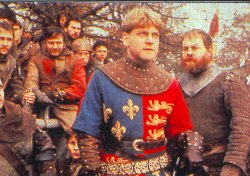
Here though is the gloriously ludicrous St. Crispin's Day speech.
"His speeches before Harfleur and at Agincourt have become the most
admired pieces of war rhetoric in the language" (Wells 155) -- by
half-wits.
|
This day is call'd the feast of Crispian:
He that outlives this day, and comes safe home,
Will stand a' tiptoe when this day is named,
And rouse him at the name of Crispian.
He that see live this day, and live old age,
Will yearly on the vigil feast his neighbors,
And say, "To-morrow is Saint Crispian."
Then will he strip his sleeve and show his scars,
And say, "These wounds I had on Crispin's day."
(IV.iii.40-48)
|
The rousing anticipation of how in the future everyone will look
back on St. Crispin's Day and ask about the wounds you received
today is followed by the expectation that their names will live
on, "Familiar in his mouth as household words" (IV.iii.52). Henry
honors "We few, we happy few, we band of brothers, / For he to-day
that sheds his blood with me / Shall be my brother" (IV.iii.60-62).
"He is very stirred; so are we; but neither we nor he believes a
word he says. The common soldiers fighting with their monarch are
not going to become gentlemen, let alone nobles, and 'the ending
of the world' is a rather grand evocation for an imperialist land
grab that did not long survive Henry V's death, as Shakespeare's
audience knew too well" (Bloom 320).
More penetrating still, who in hell ever heard of St. Crispin's
Day?! What a joke! St. Crispin is the patron saint of shoemakers,
or maybe two brothers hiding out in the eighth century as
shoemakers before being beheaded (Asimov 495)! How arbitrary
can you get?
Montjoy serves as herald to the Constable of France, and Henry
send a long defiant statement back (IV.iii.90-125).
SCENE iv
On the battlefield, somehow Pistol has captured a French soldier.
He rants, threatens, and misinterprets French words until the Boy
helps translate a ransom deal, or bribe. Afterwards, the Boy's
comment on Pistol is that "The empty vessel makes the greatest sound"
(IV.iv.69). He reports that both Bardolph and Nym are hanged now, the
latter presumably for desertion (Asimov 498), and he worries about
his own fate since only boys are left guarding the equipment.
|
SCENE v
The French realize they are faring poorly and bemoan their shame.
SCENE vi
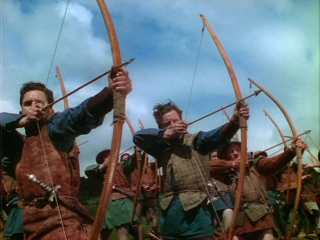
The bloody but touching deaths of Suffolk and York, who have played
no real parts in the drama, are reported by Exeter. Immediately
afterwards, apparently due to an alarum, Henry orders that his
soldiers kill all their prisoners. These "polar reversals" are
chilling (Goddard, I 249). And the issue of Henry's ordering
the prisoners killed may make him a war criminal (Sutherland 108-116).
|
|
SCENE vii
This odd scene includes some arguing between Fluellen and Gower
"among the still-smoking corpses of the 'poys' -- including Pistol's
young friend of whom we have grown rather fond" (Sutherland 113).
Gower reports that because of the French slaughter of the boys
guarding the luggage, "the King, most worthily, hath caus'd every
soldier to cut his prisoner's throat" (IV.vii.8-10). "Surely,
'worthily' is the wrong adjective. The King might much better
have done it 'sorrowfully' or 'regretfully' or even 'wrathfully.'
'Worthily' sounds sarcastic" (Asimov 501). Discussion soon concerns
whether Henry is Welsh or not and which region he's from. Fluellen
reflects on Alexander the Great, or the Big, or as his accent
renders it, "Alexander the Pig" (IV.vii.13). This symbol of
insatiable lust for blood and conquest Fluellen matches up with
Henry, albeit in spurious ways. He proceeds "by the same comparative
method exemplified in Plutarch's Parallel Lives of the Noble
Grecians and Romans" (Garber 405).
I tell you, captain, if you look in the maps of the orld, I warrant
you sall find, in the comparisons between Macedon and Monmouth, that
the situations, look you, is both alike. There is a river in Macedon,
and there is also moreover a river at Monmouth. It is call'd Wye at
Monmouth; but it is out of my prains what is the name of the other
river; but 'tis all one, 'tis alike as my fingers is to my fingers,
and there is salmons in both. (IV.vii.23-31)
"One great conqueror or "pig" is much like another" (Bloom 323).
But while Alexander "did, in his ales and his angers, look you,
kill his best friend, Clytus" (IV.vii.37-39), Gower points out
that "Our King is not like him in that; he never kill'd any of
his friends" (IV.vii.40-41). Fluellen corrects him on this:
as Alexander kill'd his friend Clytus, being in his ales and his
cups; so also Harry Monmouth, being in his right wits and his good
judgments, turn'd away the fat knight with the great belly doublet.
He was full of jests, and gipes, and knaveries, and mocks -- I have
forgot his name. (IV.vii.44-50)
This scene functions as "Shakespeare's last judgment on the rejection of
Falstaff" (Goddard, I 249). The Alexander / Henry parallels suggest
rage-aholism, but at least Alexander had the excuse of being drunk when
he killed his friend; what was Henry's? A moment later Henry enters and
insists he was always in his right mind: he was never angry "Until this
instant" (IV.vii.56). So, ironically, he unintentionally certifies that
he finally is responsible: that is, guilty.
Henry seems horrified by the slaughter of the boys and announces, "we'll
cut the throats of those we have, / And not a man of them that we shall
take / Shall taste our mercy" (IV.vii.63-65). But they already cut their
prisoners' throats supposedly -- who's left? And the reasoning for this
brutality looks like ex post facto justification (Sutherland 113).
Montjoy comes to ask for permission for the French to attend their dead.
Henry must learn that the English have won the day. "Praised be God, and
not our strength, for it!" (IV.vii.87). Despite the fact that the English
commoners won the war for Henry, "instead of expressing gratitude to the
Bateses and Courts and Williamses of his army of yeomen, Henry
characteristically attributes his triumph wholly to God.... It ends by
looking less like giving thanks to God for the victory than like putting
the responsibility on God" (Goddard, I 255).It turns out that Henry
doesn't even know the name of the castle nearby this fateful battle. Told
it is Agincourt, he announces, "Then call we this the field of Agincourt"
(IV.vii.90). Duh!
Then that wascally Henwy pulls a switcheroo and gives Fluellen the
glove so that Williams will pick a fight with him. A reference to
Henry's battle with John, Duke of Alençon (IV.vii.154f),
ignores the part about Henry having been beaten down and saved only
by his guard. He yanked a glove from the Duke at that moment? (Asimov
505). Fluellen thanks the King for the honor (of being smacked).
Henry has a chortle over the coming violence with Warwick and
Gloucester.
SCENE viii
Williams recognizes the glove and strikes Fluellen. The King and others
arrive and the trick is revealed. Clearly Henry will not make good his
vow, despite how honorable Williams comes off in this scene: "Your
majesty came not like yourself. You appear'd to me as but a common
man; witness the night, your garments, your lowliness" (IV.viii50-52).
Henry has a glove filled with crowns, and Fluellen offers an additional
twelvepence, but Williams rejects the pay-off pressed upon him: "I will
none of your money" (IV.viii.67). So "Here is a man who has no price"
(Goddard, I 254).
This scene with Williams poses the question: which is greater, man or
king? Henry compounds his honor for crowns, just as his father had done
for the English crown. After Williams leaves, Henry is concerned only
with the nobles who have died. It's clear (and historical) that he owes
victory to the common soldiers, but he says, "O God, thy arm was
here; / And not to us, but to thy arm alone, / Ascribe we all!"
(IV.viii.106-108; cf. 111-112, 115-116, 120). "To give God the credit
is to give God the responsibility" (Sutherland 123). Henry seems
to confuse Mars with God anyway. He commands that Non nobis
and Te Deum be sung: "not us," but "to God."
|
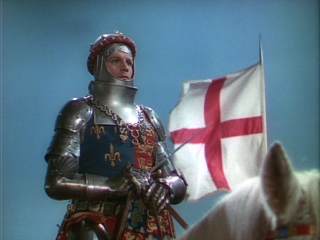
The rah-rah view is that Agincourt represents a dashing hero leading his
army with indomitable courage against a foe overwhelmingly outnumbering
them. But is there evidence of Henry's part in battle in Act IV (Goddard,
I 256)? The impression that this is a model hero leading his army
of "brothers" is an impression from Chorus and from Henry's rhetoric. We
almost do see things that are not there. But it really seems as if Henry
witnessed the war at a vantage point instead of being in the battle (Goddard,
I 257). Unlike his Shrewsbury involvement, Henry apparently did not
come to the aid of York! Henry is growing more like his father, like Henry
IV at Shrewsbury (Goddard, I 258). The Olivier film version is
memorable in making Henry V an active participant, but it's not
Shakespeare. This Agincourt act consists of Pistol (!) capturing a
French gentleman; the French lamenting their shame; Henry weeping at
the deaths of York and Suffolk, and ordering soldiers to kill all
prisoners; Fluellen comparing Henry to Alexander; and Henry breaking his
word of honor with Williams (Henry offers money which Williams rejects).
That's it.
|
Act V
Shakespeare Index